
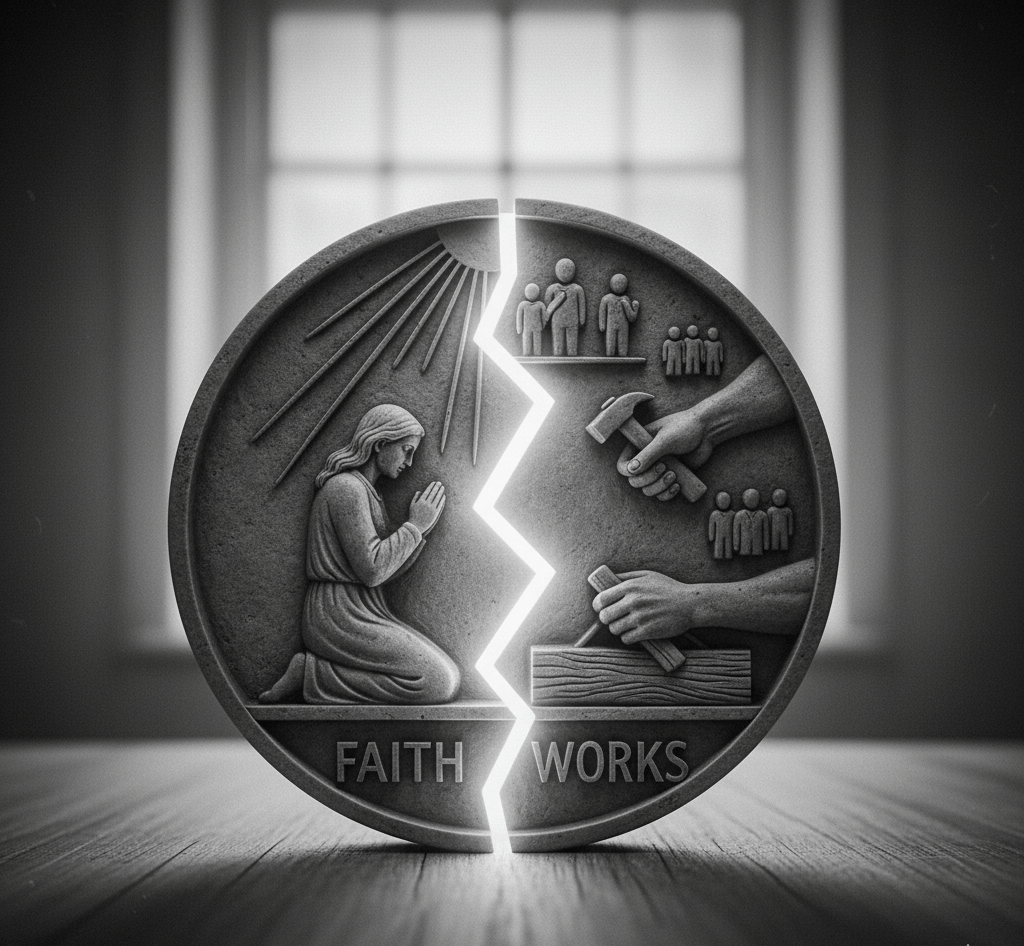
If you’ve spent any time in Christian circles, you’ve heard the debate: Are you saved by faith? Or by works?
This question has created more division, frustration, and plain old overcomplication than almost anything else. We treat them like two opposing forces—like a light switch that’s either “Faith” or “Works,” but never both. It’s an “either/or” choice, and frankly, it stresses people out.
But what if I told you the whole fight is a false choice? What if I told you that once we strip away centuries of theological baggage and just look at the simple, relational language the Bible uses, the conflict completely vanishes?
There is no dichotomy between faith and works. One is simply the natural result of the other. Paul and James are not in contention but in addressing different topics and in different aspects of this life we live while in alignment with the King.
The Vocabulary of Loyalty: Patron and Client
To understand how Faith and Works fit together, we have to look at the world the New Testament writers lived in. They weren’t using abstract religious terms; they were borrowing vocabulary from the everyday economic and social system known as the Patron-Client System. We’ve talked about this before in the context of The Realignment of Faith, but it bears repeating because it’s the key to unlocking this whole discussion. The common New Testament words for “faith” (Pistis) and “grace” (Charis) aren’t abstract theological ideas; they are borrowed directly from the ancient world’s Patron-Client system.
This system was the foundation of society, and it gives us the keys to our two most important words, which describe the finished action of God and our necessary, continuous response:
- Charis(Grace, Favor, Gift):
- This is the gift or favor (Grace) given by a Patron (someone with wealth and power).
- It is unearned and freely given.
- When the Bible says we are saved by Grace, it’s telling us that Jesus (our Patron) gave us the ultimate, unearned Gift—salvation and eternal life.
- Pistis(Faith, Belief, Allegiance, Trust):
- This is the full loyalty and commitment expected from the Client (the person receiving the gift).
- It is complete trust in the Patron’s ability and character.
- The Greek verb form for “believe” (pisteuō) is often used in the present tense in the New Testament. This is important: The present tense indicates continuous, ongoing action.
To survive in that world, you needed a Patron—someone with power, status, or limited-access resources (like land or political pull). The Patron would provide a Gift or Favor to the client. This gift was called Charis, which we translate as Grace.
In return, the Client’s role was to offer their complete allegiance, loyalty, and commitment to the Patron. They were to speak well of him, be dedicated, and place their absolute trust in his authority and provision. This total commitment was called Pistis, which we translate as Faith.
When the New Testament declares that Christ is our Patron and offers us the ultimate Charis (eternal life and restoration), it then calls us to be His Client: to have Pistis in Him, to give Him our total Allegiance and Trust as an ongoing state of being.
This is where the magic happens. The Patron-Client system is not a single transaction—it’s a relationship of reciprocity. As long as the Patron provides the gift, the Client is expected to live out their Pistis.
Works Are The Way We Live Out Our Faith
The fatal flaw in the “Faith vs. Works” debate is that we define “works” as something you do to earn the gift (Charis). That would be like a client trying to buy the Patron’s favor. It fundamentally misunderstands the system.
Instead, works are simply the inherent, natural, and expected behavior of a person who has committed to Pistis.
If you have complete trust (Pistis) in Jesus Christ as your King, your Patron, and the one who has given you the gift of life (Charis), how then shall you live?
The answer is: you will live in a way that honors your Patron. You will align your life with His commands. These actions— loving your neighbor, serving the poor, striving for righteousness, the practical outworking of Christian living—these are your works.
They are not the price that makes the transaction happen; they are the natural behavior of a person whose life has been fundamentally realigned by the gift they received.
The Apostle James nails this when he says that “faith without works is dead” (James 2:17). He isn’t adding a condition to salvation. He’s simply saying, “If you claim to have total Allegiance (Pistis), but your life doesn’t show a single action (work) of that loyalty, then your allegiance is fake, worthless, and dead.”
The works are not the root of the plant; they are the fruit. The root is the gift of grace received through allegiance (faith). You don’t get the fruit by trying to staple works onto a dead branch; you get the fruit by being deeply, relationally connected to the vine (the Patron).
The Uplifting Reality of Our Realignment
So, let’s stop worrying about the fight between Faith and Works.
Our salvation is settled entirely by the Grace (the unearned Gift) of our Patron, Jesus Christ. That’s the beginning. That is the gift that Paul calls us to have faith in our patron for. This is the faith we live out through our allegiance to Christ (our patron) and naturally generate works. Living in faith continuously moving forward, not dead in deed as exhibited in one-time acceptance.
The moment we accept that gift and enter into a relationship of Faith (total Allegiance), we are fundamentally realigned. We now belong to a new King, and our life is meant to reflect that. Our actions—our works—are no longer an anxious attempt to earn love; they are the joyful, confident evidence that we have already received it.
Keep focusing on your Faith. Keep deepening your trust in your Patron. The works won’t be a spiritual chore; they will be the most beautiful, visible proof that you are His.
Keep striving, keep trusting, and watch your works become the most beautiful, visible evidence of your faith.
 Simplifying Christianity