
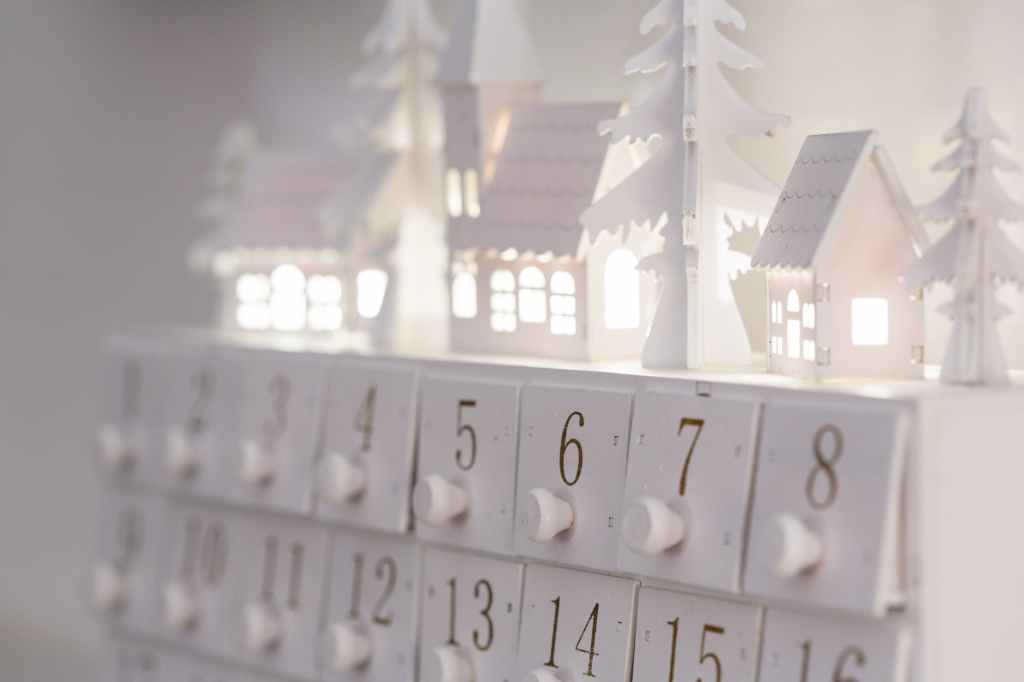
As it comes to the close of the year, you start to see the countdown to Christmas. There are so many traditions that come to life at this time, including something that many of you do but may not know what it actually is, Advent. To some, this may take the form of a countdown calendar for the first 24 days of December. For others, this may be a four-week candle lighting ceremony in your church service. Either way, whether you know it or not, you are participating in a Liturgy of Advent (or a habit of Advent, but we will get to that in a little bit).
For those of you that buy a countdown calendar (usually some sort of prize per day or moving marker on a 24-square display), you may see the word Advent printed on the box. This 24-day countdown tradition associated with Advent calendars originated in the 19th century in Germany among Lutheran families. The exact year of its inception is unclear, but it is believed to have emerged between the 1820s and 1850s. Early Advent calendars were often homemade, consisting of 24 small boxes or bags filled with treats, such as candy, nuts, or small toys. By the late 19th century, commercially produced Advent calendars began to emerge and then became widely popular throughout Europe and North America by the early 20th century.
This adaptation of Advent is actually a late addition to the tradition family. The more reflective tradition of the original advent is the lighting of four candles within a wreath. This modernized form of the tradition is celebrated by an estimated 80% of Christian churches with the majority being in Western Christian churches (Eastern Christian churches, such as Orthodox churches, typically do not observe Advent in the same way, but they may have a similar period of preparation before Christmas). Each of these Candles end up representing an element that is focused on that week: Hope, Preparation, Joy, and Love. This “Focus” is what is tying it back to its original intent.
The Origin of Advent actually started somewhere around 4th and 5th centuries in Spain and Gaul. It was initially a time of fasting and prayer, and it was not until the 6th century that it became associated with the celebration of Christmas. It was in this 4th and 5th century that the church began to bring structure to what is called the “Liturgical Year”. Advent’s origins actually had an element of fasting and abstinence tied to it, and this was also seen as an established part of Lent by the 5th century (Lent is the other staple point in the Liturgical Year). It was in the 6th century that we saw Advent tied to Christmas and the 7th-11th centuries that the Liturgical Year evolved to include feasts and commemorations of the saints. By the 12th-16th centuries, the Liturgical Year became increasingly standardized, with the establishment of fixed dates for feasts and the development of liturgical texts and practices. It wasn’t until the Council of Trent (1545-1563) that the Catholic Church undertook a series of reforms to its liturgical practices which included the standardization of the Liturgical Year. This standardization helped to solidify the structure of the liturgical year and ensure its consistent observance throughout the Catholic world.
These two staples of the Christian faith, Advent/Christmas and Lent/Easter have influenced the culture so much that these two Holidays (Holy Days) continue to drive their elements in the secular culture. This carry-over has happened to such a degree that many have actually forgotten what the intention of Advent is or what the word even comes to mean. The word Advent itself actually comes from the Latin word “Adventus” which means “coming” or “arrival”. And no, this does not mean the coming of Jesus as a baby. This Latin word is actually a translation of the Greek word “Parousia” which has a similar meaning of “Arrival” (or more precisely, the transition of the verb “par-ein,” which means “to be present” or “to be there” and turns it into a noun by adding the suffix “-ia” to the verb stem of “par-“ which gives it the meaning of “Presence” or “Arrival”). So, if it is not the arrival of Jesus as a baby then what is it the arrival of?
Where we constantly find the use of this Greek noun in the New Testament is actually tide to the coming of Jesus a second time, “His Arrival”. That’s right, the focus of Advent is actually a Liturgy of remembering that Jesus will return. This makes it so that when we focus on the start of his earthly life (Christmas) and the end of his earthly life (Easter), we are actually making it a habit to remind ourselves that those events are not the end of the story. Instead, we as Christians are to be constantly looking forward to his “Arrival”.
At this point, you may be wondering why I keep using the terms Liturgy, Holiday, and Habit interchangeably. If you haven’t figured it out, let me declutter it for you. We all have a pretty good grasp of what a habit is. Sometimes we have “bad habits”, but these are not really habits but rather succumbing to an action because it was easy (habitual). The real power behind a habit is the “Good” we intend to see come out of it. So, we create the “Good Habits” to consistently move in a direction or keep a right mindset. It is in this that “Liturgy” is born. If you remove all of the pomp and circumstances of Liturgies that we see in the church setting, they all boil down to being an intention to remember what the right mind set is, a “Good Habit”. Holidays, or “Holy Days”, are just Liturgies that have been set to a specific time. These Habits (Liturgies) may have evolved through time, but they have always been a means to teach and remind us of what we want to have in mind as we move through the days and years of our lives.
So, what is the takeaway from all of this? Two major points. The first is that there is nothing mystical about Liturgies or Holidays, but it is a Habit that has been built into the Christian culture to help remind us that we are tied to Christ (claim him as our Patron). The second is that Advent, although it leads up to Christmas, is really not about Jesus’ birth. Rather, when we claim our allegiance with the Christ, we are looking forward to his return (whether in our lifetime or not) when he will close out this age with his earthly rule. For, it is at that time, we as Christians will see something new and that is what we are reminding ourselves of in the form of a Habit called Advent.


One response to “The Habit of Advent”
[…] corporate service of the church. However, this distinction is a gift. As we discussed in “The Habit of Advent,” genuine faith is built on intentional, daily practice. The communal liturgy (leitourgia) […]
LikeLike